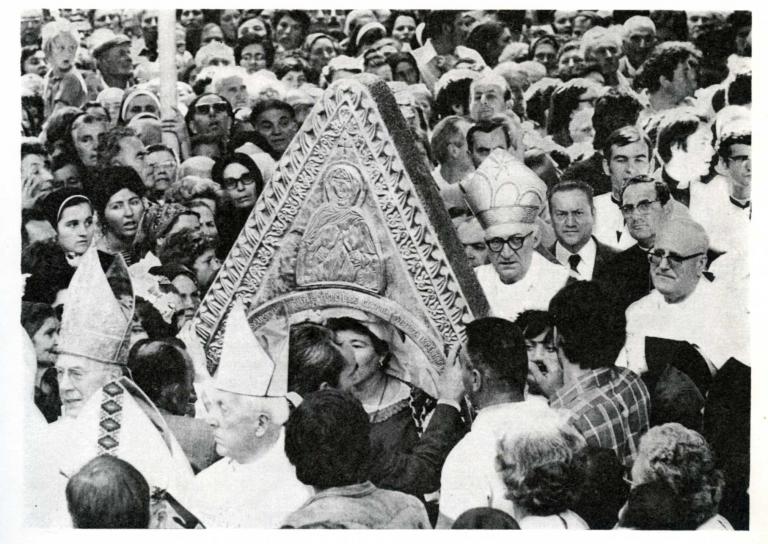
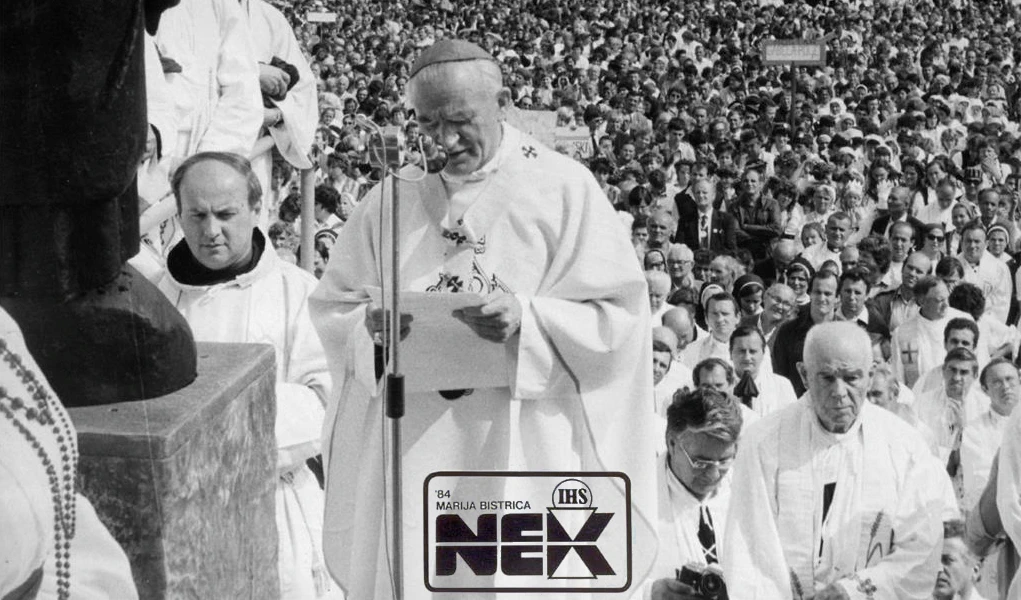
40 years ago, on September 8 and 9, 1984, the National Eucharistic Congress was held in Marija Bistrica, celebrating 13 centuries of the baptism of Croats and the 300th anniversary of the discovery of the miraculous image of Our Lady of Bistrica. The Mass celebration on September 9 gathered more than 400 thousand faithful, and we are reporting the homily of the servant of God, Cardinal Franjo Kuharić, in its entirety.
Come, Lord Jesus! (Rev 22:20)
I am with you always, to the end of the world! (Mt 28:20)
Dear pilgrims!
Beloved brothers and sisters in Jesus Christ, our Lord! Praise be to Jesus and Mary. “I observe how the joyful and proud assembly of saints, who, summoned by the holy Theotokos and ever Virgin Mary, have come here with ready hearts… Now the word of the psalmist David has been fulfilled upon us: Behold, there is nothing so good or so pleasant as when brothers dwell together! I greet you, holy and mysterious Trinity. You have called us all to this Church of the holy Mary the Theotokos. We greet you, Theotokos Mary…, Mother and Virgin, by whom in the holy Gospels He who comes in the name of the Lord is called blessed” (Book of Hours N.B., p. 2516).
These words of greeting, with which I greet you all heartily, were spoken long ago. Thus did the holy Bishop Cyril of Alexandria greet the Council of Ephesus in the year 431. At that Council, the Mother of the Incarnate Word – the Son of God – receive the solemn and real title of Theotokos!
Today, here in the sanctuary of Our Lady of Bistrica, the solemn assembly of the Church in Croatia has gathered to conclude the celebration of the great jubilee: Thirteen Centuries of Christianity in Croatia.
Following the ancient words of Mary to Jesus, here in the sanctuary of the Mother of God, with our National Eucharistic Congress, we wish to sing together with Mary: My soul magnifies the Lord… for the Almighty has done great things for me, and holy is his name (cf. Lk 1:46; 49). With this Eucharistic celebration, we wish to sing a hymn of thanksgiving for the great gifts of God: for the gift of baptism, through which Redemption began to take place in the being of the Croatian people thirteen centuries ago; we wish to give thanks for the perseverance in faith and communion of the Catholic Church; We especially want to thank the Lord for the priceless gift of the Eucharist, for the miraculous sacrament of the Body and Blood of Christ in which the Redeemer, our Jesus Christ, permanently realizes in his Church and for his Church his unbloody Sacrifice, his Feast and his living Presence.
With this Congress we want to pray for the strength of faith for our days and future times: we also want to pray for forgiveness for the sins of our people. We include in the concluding celebration of the great jubilee the jubilee of this Marian shrine, because three hundred years ago, on July 16, 1684, the Image of the Mother of God of Bistrica was found again, which was hidden in the wall of the church due to the war dangers of those times.
With the Most Holy Theotokos, we pray for the light of the Holy Spirit that this Congress may bear the desired fruits in our Church and our people! May all past generations of the righteous, saints and martyrs of the thirteen-century history of the Church in Croatia, gathered together in the heavenly Church, pray for this with us. God became incarnate and was born of a Virgin to be God with us – Emmanuel (cf. Is 7:14). Thus he revealed his love for man. God is God for man. And man truly realizes himself when he is man for God. The relationship of man to God is revealed in the relationship of man to man. Thus an ever more perfect human brotherhood arises and grows in truth, justice, love and freedom. The source of this brotherhood is God to whom we address our prayer: Our Father! Jesus taught us to pray in this way. That is why he said to his disciples: “… You are all brothers!” (Mt 23:8). Unity in God the Savior is the most human brotherhood. God loves man. Man is called to love God. This is what faith teaches us. This is God’s revelation. Our forefathers believed in this truth thirteen centuries ago. “And we have come to know and believe the love that God has for us” (1 Jn 4:16). We believed freely. Not forced by anyone, on the contrary: during the difficult centuries, many Croats were torn away from this faith by great temptations: of course, there were also those who voluntarily excluded themselves from this faith. However, the vast majority of Catholic Croats, even with the greatest sacrifice, resisted force and preserved their faith.
As we delve into history, let us remember that on this very day, September 9, 1493, the flower of the Croatian people perished on the Krbava Field. We are proud that our forefathers believed freely. There is no faith and love without freedom. God is perfectly free in all his works: both in the work of creation and in the work of Redemption. He freely wants to give himself to man. And man must be free to be able to give himself to God. Therefore, the demand of justice is that man be completely free for God, not only in his soul, but also in his external relations. To prevent man in any way from seeking God and being God’s is a grave violation of justice and human dignity. In a certain sense, this means preventing God himself from being present among people, from saving man. It is a great mistake to claim that man is free precisely when he excludes God from his conscience and his life, when he completely breaks off all relationship with God. In some parts of the world in our time, the process of atheism has even become a program of education and public life. This, however, cannot be done without coercion on people’s consciences. However, even the most modern experiences show that a better world, to which all people of good will aspire, regardless of their different beliefs, is not possible without spiritual values: it is not achievable without objective moral principles. The path to human happiness is only that along which God and man walk together!
God – present in human reason as Truth, in human conscience as the highest Good, in the heart as the most sublime love – makes man just in all relationships, conscientious in duties, selfless in action. Such a man, no matter what system he lives in, can be the builder of a truly just society, a better world.
When the Church – everywhere in the world – seeks full freedom to carry out her mission, which Jesus Christ himself entrusted to her, this includes the freedom of every believer to live her faith publicly and to confess it publicly: this is ultimately the freedom of Jesus Christ himself to free people from sin, from every evil within themselves, and to raise them with his Holy Spirit to the dignity of sons and daughters of God.
The freedom of the Church is in fact the freedom of Jesus Christ to freely change man and thus change the whole world for the better. Jesus Christ is present in the Church through his word; he is present in her through the sacrament; he is present in the communion of the Church. “For where two or three are gathered in my name, there am I in the midst of them” (Mt 18:20).
The fullest and most miraculous presence of Jesus is realized, however, in the Eucharist, in the sacrament of his Body and Blood. There he is truly present, “vere, realiter et substantialiter”, with his divinity and his humanity transformed by the glorious resurrection. In the full sense of the Eucharist – under the species of bread and wine – Jesus Christ, true God and true man, fulfills his promise: “I am with you always, to the end of the age” (Mt 28:20). In every Mass he says to his Church: “I have eagerly desired to eat this Passover with you…” (Lk 22:15).
The Eucharist is the sacrament of communion between God and man and man with God; it is the sacrament of the fullest communion among the members of the Church. Never are the faithful so deeply united with one another as they are around the altar in the Eucharist. Nothing brings man closer to man than communion. That is why the Apostle Paul wrote to the Corinthians: “The cup of blessing which we bless, is it not a communion of the blood of Christ? The bread which we break, is it not a communion of the body of Christ? Because there is one bread, we, who are many, are one body…” (1 Cor 10:16-17).
The communicant receives the living Redeemer; but this Redeemer Jesus Christ is God for every person. Therefore, the communicant must receive every person into his heart. Through Communion, we are nourished by love for every person, regardless of their nation, race, faith or belief. Has not this Eucharistic Congress of the Church in Croatia gathered us together with the faithful Slovenians, Hungarians, Slovaks, Poles, Czechs, Italians, Germans, Albanians – with the faithful from all the neighboring nations in which our Church lives! Do we not also meet in this Eucharist with representatives of other Christian communities: with representatives of the Serbian Orthodox Church, the Evangelical Church and others! Are we not meeting here as heirs of the faith of Abraham and representatives of the Islamic community? Are there those among us who do not have faith, and are they also accepted with the respect of believers, because Christ died and rose for them too?
A person who receives communion is open to everything with sincere intentions. He is only irreconcilable with evil, with sin. Sin rejects God, rejects his love and truth, and thus rejects man. Everything that is against God also endangers man. Therefore, the communicant knows that one must approach God’s table with a pure heart.
The Eucharist is food for eternal life, but it also transforms earthly life. The communicant strives for justice out of love; he must be a man for the poor, the hungry, the anxious, the persecuted and the lost. No one may prevent a worthy believer from receiving communion at God’s table; only grave sin makes the faithful incapable of receiving communion, therefore he knows that then his path to communion is through a contrite, good confession.
Therefore, the Church demands complete freedom so that every believer, regardless of his service and situation, has the opportunity to participate in the Eucharist. This is the freedom of religious life, both privately and publicly. A truly free society is one in which every person is free to live with God. We emphasize as an inalienable human right that all believing citizens can celebrate the Eucharist publicly, that no one has to hide, that no one has to fear any reproach or threat. The Church, in the name of God, encourages its believers to contribute to the well-being of the entire people and the entire community through conscientious and honest work and life in every social or state reality. Believers are promoters not only of material progress, but also of ethical and spiritual progress. But the Church also, in the name of human dignity and in the name of God, rightly warns of problems where this religious freedom has not yet been fully realized. This is neither opposition nor hostile action, but a consistent proclamation of evangelical love and justice in freedom.
Complete freedom includes the freedom of religious education of children and young people in accordance with the conviction and conscience of parents; it also includes the possibility of building worthy spaces for the celebration of the Eucharist where believers live. This freedom includes the consistent possibility of the faithful, the dying, the sick, prisoners, and soldiers to celebrate the Eucharist and receive the sacraments. All these freedoms protect the dignity of the human person and elevate the entire society to a higher level of humanity; they are included in the concept of humanism.
Celebrating the divine-human meaning of the Eucharist, the Church must intercede in the name of God for every person everywhere in the world, in all circumstances. Jesus Christ – the only Redeemer of man – sent his apostles, his bishops, and priests to every nation. This means that we are first sent to our people in whom we were born and with whom we live. It is human and evangelical to rejoice and mourn with our people, to share good and evil with them. This is how the Catholic Church has lived among the Croatian people for thirteen centuries. We manifest our evangelical patriotism most truly when, through the Redemption, we strive to heal the soul of our people from the deadly evils that destroy the individual, the family, and the nation. Thus we build a civilization of life and love. Our great jubilee has also called us to an examination of conscience. And this Congress of ours should put us in the mood for great decisions, for true conversion. We heard today that the great prophet Elijah, all committed to the true God and the conversion of his people, became weary. “I have had enough,” he said (1 Kings 19:4). He heard the voice of an angel: “Arise and eat” (1 Kings 19:5).
A Christian also has a prophetic call to bear witness to God with his life. Weak within himself, exposed to the temptations of the world and the invisible tempter, a Christian can also become weary. But the Eucharist, worthily consumed, gives him the strength to be courageous and faithful. In the Eucharist, young people can gain strength to be innocent, preserved, and honest. Fathers and mothers, strengthened by the Eucharist, live faithfully and respect life. They rejoice in their children; the Eucharist protects priests, nuns, and religious to always be of God! By the power of the Eucharist, we must prophetically strive to cleanse our speech of blasphemous curses and curses; we must prophetically strive to stop the flood of abortions, which are already becoming a real genocide! We must courageously emphasize that the goal of conjugal love is not selfish enjoyment in which a person is turned into a means, but mutual enrichment in selfless love; the dignity of conjugal love is truly threatened by unnatural methods of avoiding the creation of new life. As believers in the Church and as citizens in the national community, through education, example and prayer, let us help young people to resist immorality, drugs, alcohol, and to preserve their faith.
With this National Eucharistic Congress, we conclude the solemn and joyful celebration of the great jubilee. Will we carry the sacred heritage of the Catholic faith into future centuries? May this day, which we have reached after a long journey of thirteen centuries, often watered with blood and tears, be a bright station on this great pilgrimage of ours! May it be a day of our firm decision and fervent prayer: “Come, Lord Jesus, Maranatha!” Come, return to our consciences, to our families, to our personal and public lives! And He answers us; “Come to me, all you who labor and are heavy laden, and I will give you rest” (Mt 11:28). With Him we will not be weary for good!
On this solemn and joyful day, in this holy communion, gathered from all parts of our homeland and beyond, gathered in the sanctuary of Our Lady of Bistrica around our God and Savior who gives himself to us under the appearance of the bread of life and the wine of joy, let us confirm our Covenant with God. Let us once again firmly and irrevocably choose Jesus Christ, that he may be our Way, the Truth and the Life today, tomorrow and always (cf. Jn 14:6)! Let us awaken and strengthen our devotion to the blessed Mother of our Lord and the Mother of our Christian history! Let us awaken our faithful devotion and obedience to the Bishop of Rome, who is the visible sign of the unity of the Church in truth and love! Let us repeat our Great Vow from Solin in 1976 and the important decisions from Nin in 1979. “The Croatian Catholic family prays daily and celebrates Mass on Sundays.” This is true for every Catholic family in every nation and for all times.
Today, before Jesus and all of heaven, we will entrust ourselves and all that we have to the Immaculate Heart of Mary. The Mother of God and Mother of the Church calls us to prayer and penance, so that in this troubled world and anxious time, God may bring about his victory of Peace.
Today, we have heard the word of God, which urges us to keep the unwavering faith of hope, to watch over one another and to incite one another to love and good works; it especially admonishes us not to forsake our meetings (cf. Heb 10:22-25), and therefore to gather together diligently in the Eucharist. And let us go forward with our God! With all the heritage of a difficult and glorious past, with all the experiences of the present and with all the hope of an eternal future. Strengthened by the Eucharist, under the protection of Mary, let us go with God into the days to come, into the years to come, into the centuries to come – until the Lord comes (cf. 1 Cor 11:26)! The Apostle Paul writes to the Romans and to the Church of all times: “If God is for us, who can be against us? Who shall separate us from the love of Christ? Shall tribulation, or distress, or persecution, or famine, or nakedness, or perdition, or sword?… In all these things we are more than conquerors through him who loved us. For I am persuaded, that neither death, nor life, nor angels, nor principalities, nor powers, nor things present, nor things to come, nor any other creature, shall be able to separate us from the love of God which is in Christ Jesus our Lord!” (Rom 8:31,35-39).
So be it! Amen!