How the Catholic Church in Solin emerged from the catacombs in 1976 and shone like a city on a mountain
Among the important anniversaries coming up in 2026, the 50th anniversary of the celebration of the Year of Helena and the Croatian Marian Year in Solin holds a special place. The grand celebration on Gospin Island in September 1976 gathered a large crowd of Croatian believers – according to some estimates, several tens of thousands, and according to others, more than a hundred thousand. The events in Solin were a historical turning point in which the Church emerged from the catacombs in a grand manner, shone like a city on a mountain, and began its decisive spiritual momentum despite the atmosphere of communist repression.
From ancient Salona to “Stalingrad”
There could not have been a better or more important “stage” for such a bold move at that historical moment. Solin, built on the foundations of ancient Salona, is where the ancient roots of Christianity among Croats and the foundations of Croatian statehood are woven. It was where rulers and kings of Croatian blood reigned during the Middle Ages. It is also known that in the 9th century, Prince Trpimir built a Benedictine monastery there. In 976, Queen Jelena built the first known Croatian Marian church in Solin. In Solin there was also the Church of St. Stephen with the tombs of Croatian kings, as well as the coronation basilica of King Zvonimir, Dvorina, Gradina and, above all, Gospin otok as a kind of summary of all the magnificent historical traces of Solin and centuries-old spiritual impulses. After all, Solin had already once proven itself as an important bulwark – in the dramatic times of the transition from the 19th to the 20th century – when a dark cloud of denial of national and state identity and foreign claims, sometimes Great Hungarian and Austro-Germanic, sometimes Italian-irredentist, loomed over the Croats. Namely, it was in Solin in 1898 that the great Don Frane Bulić dug up old stones and among them discovered and deciphered the tombstone inscription of Queen Jelena, which contained the genealogy of the Croatian kings.
But there was another side. Namely, the image of historical Solin was in sharp contrast to the image of Solin after the communist takeover in 1945. It was a small town forcibly transformed into “Stalingrad” – a large barracks whose barbed wire reached right up to the church on Gospin Island and an industrial center whose factories and concrete apartment blocks were to be populated with “new people” such as the promise of a communist “paradise on earth” demanded.
The starting point of “Thirteen Centuries of Christianity in Croats”
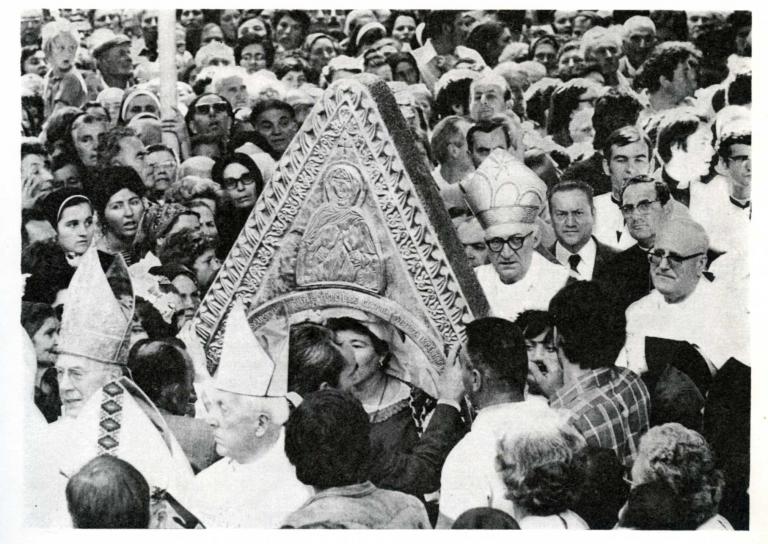
The closing ceremonies of the Year of Helena and the Croatian Marian Year in Solin lasted a week, from 5 to 12 September 1976, and during those days the programs, catechesis and theological congresses extended to Split, Omiš, Trogir, Kaštela… The solemn Mass on the Island of Our Lady was presided over by Cardinal Franjo Šeper, then head of the Congregation for the Doctrine of the Faith and envoy of Pope Paul VI. He was accompanied by six other cardinals (among them Albino Luciani, the Venetian Patriarch and future Pope John Paul I) and several dozen archbishops from abroad, as well as the entire Catholic episcopate from the territory of Yugoslavia at the time and about five hundred priests. Faithful in traditional costumes, young people, numerous pilgrims arrived from all over Croatia, Bosnia and Herzegovina and other regions where Croatian Catholics have lived for centuries… Archbishop Franić, as the host of the ceremony, said: “We will dedicate this concelebrated Holy Mass to the renewal of faith in the Croatian people, especially for the good Christian upbringing of our children and our young people, for our families, for peace and love between religions and peoples, for penance for our sins and those of our people, for thanksgiving to the Triune God for all the graces He has bestowed upon us throughout our thirteen-year history, especially for the great and priceless grace of baptism.” Zagreb Archbishop Franjo Kuharić led the Prayer of the Great Vow.
The Solin festivities in the 1975/1976 biennium proved to be the starting point of the cycle of jubilee pilgrimages entitled “Thirteen Centuries of Christianity in Croats”. After Solin, the celebration in the Diocese near Knin followed in 1978, continued in Nin in 1979, and culminated in the National Eucharistic Congress in Marija Bistrica in 1984. And the Bistrica pilgrimage river, into which half a million believers poured, showed how, with the project “Thirteen Centuries in the Croats”, the Catholic Church made a spiritual contribution to breaking the chains of Yugoslav communism, but also prepared the ground for the defense of Croatia from the Greater Serbian aggression of the 1990s.
The far-sighted ideas of priests Živko Kustić and Tugomir Jovanović
The grand celebration on the island of Our Lady in Solin in 1976 was preceded by a series of complex intra-church processes. The idea that the important anniversary of the first Marian church in the Croatian people should be “commemorated” in some way had actually been maturing for decades. First, in 1965, the Archbishop of Split and Makarska, Frane Franić, announced that the decade leading up to 1976 would be celebrated as spiritual preparation for the thousandth anniversary of Jelena’s Marian church.
In his ideas, Archbishop Franić found a faithful and strong collaborator in the figure of the Solin parish priest, Tugomir Jovanović. A priest with an unusual biography – who as a young seminarian first survived the Bleiburg tragedy and the Stations of the Cross, and upon returning to his native Postira on Brač was thrown into a communist prison – left an indelible mark on Solin. When Archbishop Franić entrusted him with an important task in the mid-1960s, Pastor Jovanović worked tirelessly on the spiritual elevation of Solin’s “holy hill”. Thus, by the early 1970s, Solin was revived as a symbol of the beginnings of Christianity among Croats and one of the progenitors of Croatian identity.
Such potential of Solin could not remain untapped. Other elders of the Church in Croats, not only the Archbishop of Split-Makarska, sensed that something more was hidden behind it. After all, the current historical moment also demanded a more important step forward – these were the difficult, leaden years of Croatian silence, after the suppression of Croatian dreams and aspirations at the session in Karađorđevo at the end of 1971. It was literally a matter of “to be or not to be” – to stay afloat, to fight, or to drown and be executed in a new wave of dark communist repression.
Since Karađorđev, the Church has slowly but courageously taken on the broken banner of Croatian national identity alongside its pastoral tasks. In the early years, it was actually searching for the right expression. This expression was born in the heart and thoughts of Živko Kustić, a Greek Catholic priest, a famous preacher, who as a journalist and editor-in-chief of Glas Koncila became one of the strongest voices and the first pens of the Church among the Croats. Given the upcoming anniversary of Jelena’s church and the general symbolism that Solin bore, it was necessary to somehow build a point of national spiritual gathering from a “local thing”. Thus, the idea arose to connect the year of Jelena with 641, the year in which Abbot Martin, on the instructions of Pope John IV, visited Istria and Dalmatia and became acquainted with the local Slavic population – the Croats – which is also considered the first documented encounter of the Croatian people with Christianity and a representative of the Holy See. This anniversary was also to be celebrated during the time when the Zagreb Archdiocese was governed by Alojzije Stepinac. In 1940, the celebration of the Holy Year was solemnly opened, but its grand conclusion was interrupted by the beginning of war in Croatia in April 1941. And in the mid-seventies, Kustić also found a faithful ally and collaborator for his ideas in the figure of the tireless Solin parish priest “Don Tuga”.
Solin was constantly “as bustling as a beehive”
And so Stepinac’s Holy Year was “resurrected” as part of the jubilee of Jelena’s church, and this opened up the space for the festivities in Solin to become “something more”, with a pan-Croatian religious significance. However, in unfavorable political circumstances, it had to be done step by step. The bishops first decided that Jelena’s Year would be celebrated as the Croatian Marian Year from September 1975 to September 1976. The jubilee proclamation of the Croatian bishops also appeared, and then the encyclical “Thirteen Centuries of Christianity in the Croats”. The Theological Olympiad took Queen Jelena as its theme, and various materials and contributions for adult catechism and sermons were prepared with the aim of raising awareness of the important jubilee. Thus, all the contours of the great celebration in Solin were outlined.
With the celebration in Solin in 1976 and other jubilee celebrations as part of the project “Thirteen Centuries of Christianity among Croats”, the Catholic Church made a spiritual contribution to breaking the chains of Yugoslav communism, but also prepared the ground for the defense of Croatia from the Greater Serbian aggression of the 1990s.
From the opening of the Croatian Marian Year in September 1975 to the final celebration in September 1976, Solin lived in a special atmosphere and spiritual ecstasy. The priest, historian and theologian Drago Šimundža, who was a direct participant and eyewitness to everything, writes in the collection »One Hundred Years of the Parish of Our Lady of the Island of Solin: 1911 – 2011«: »As we know, these were joint celebrations in which the entire Church of the Croatian people, in small and large groups – personal, family, parish, professional and diocesan – joined together in a single procession and proudly rushed to the graves of the early Christian martyrs and Croatian kings, to Our Lady of the Island and the Jadro River, the symbol of Croatian baptism, in order to raise awareness of its past on these sacred foundations, both ecclesiastical and social, and to build its current present and future on its values.«
In the same book, priest Šimundža, who regularly recorded what was happening in Solin for Glas Koncila in 1975 and 1976, brings another impressive picture of Solin. “The whole morning was bustling like a beehive; some coming, others going; they meet, wait and pray together. Several pilgrimages lined up, so that each one for himself, one after the other or several together approached the historic altar in front of Jelena’s shrine. After the regular morning masses of the Solin parish, the first to approach the altar were the young people from the heart of Herzegovina. After them, our Greek Catholics followed with their rich liturgy of St. John Chrysostom. After them, at around 11 am, the main service was given to the Zagreb pilgrimage, then to our seminarians, nuns and other pilgrims from the Solin area,” said Šimundža, describing the colorful mosaic of the Church among the Croats that gathered in Solin on just one May day in 1976.
After Solin in 1976, “progressives” also became “nationalists”
The development of the situation left the Yugoslav communists in shock. Such a movement – whether due to internal political reasons, or due to the mask of a “peaceful” country that they were putting before the world public – could no longer be stopped by brute force. And besides, the Church also showed great unity. The alleged division between “progressives” open to cooperation with the regime and irreconcilable “conservatives” of the Stepinac line, a gap that the communists tried to oversize in the years of intra-church post-conciliar turmoil, simply no longer made sense. This is best evidenced by the “disappointment” of Fr. Tomislav Šagi Bunić – whom the regime considered a theologian and intellectual prone to compromise with the communists – which Stipe Šuvar expressed at a high-level party forum shortly after the celebration in Solin in 1976. “We assessed Šagi Bunić and his movement as post-conciliar, modernist, however, then in the national question she is the bearer of the nationalist course.” Šuvar found it objectionable that Fr. Šagi was one of the creators and authors of the episcopal letter “Thirteen Centuries of Christianity in Croatia.”
Source Glas Concila No.1/2026