Front of the Shirt
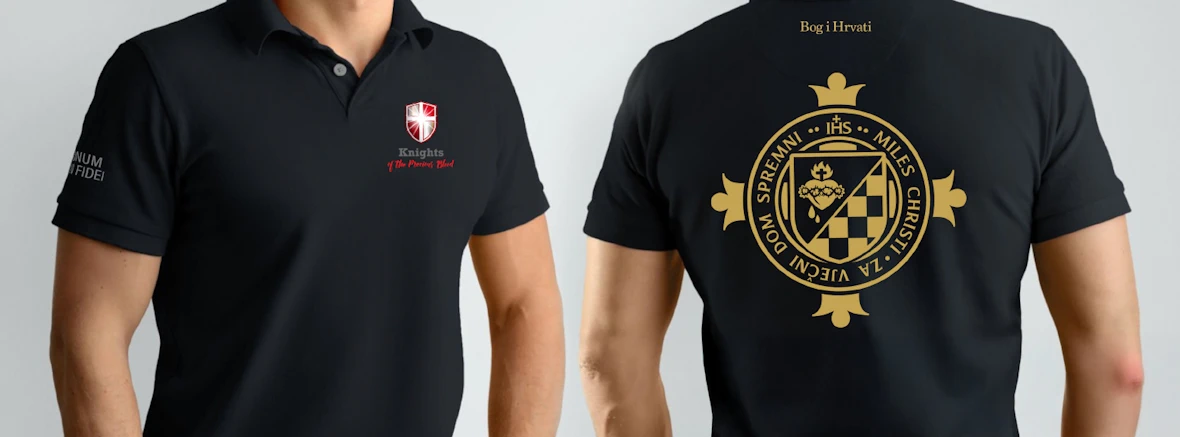
Shortly after the Knights of the Most Precious Blood were formed in 2015, the group’s emblem was designed and confirmed by the founding members. The emblem was intended to embody the charism and chivalric code of the Knights, combining fidelity to Christ with Croatian heritage.
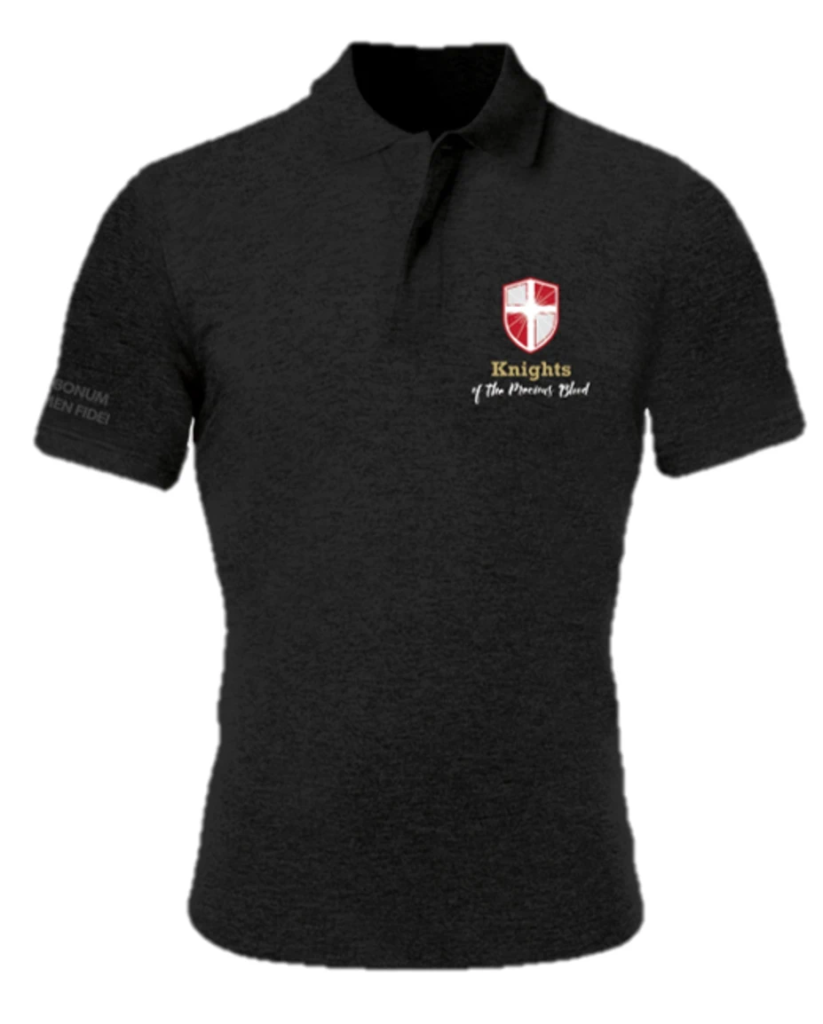
The founding members all agreed that the Knight’s emblem should include a shield in the colours of the Croatian emblem (grb), with the Cross of Our Lord as the centrepiece of the shield. This was to emphasize the belief that the Holy Cross is our shield and our victory. Our Lord shed his Most Precious Blood on the Cross for us and it is the Most Precious Blood that we call upon daily for our protection. The rays emanating from the Cross represent the glorious victory over death that was won by our Lord on the Cross. This glory of the Cross, the victory of the Blood of the Lamb, is our Shield and our Strength.
The Black Colour of the Shirt is to remind us of our Lord’s Passion and death on the Cross and the Sorrows of Our Lady.
Back of the Shirt
“Bog i Hrvati” or “God and Croats” is to remind us that God is always first in our lives and through God, in God, and with God, we Croats we are adopted sons of the Most High through our baptism and soldiers of Christ through our confirmation.
The graphic design on the back of the shirt is partially inspired by the St Benedict Medal and signifies the spiritual combat we are all called to. On the rim of the emblem there are inscribed several words and letters. In the prime position, above all other inscriptions is the well-known monogram of the holy name of Jesus, “IHS”. Faith, and our own experience, convince us of the all-powerfulness of this divine Name. That in the name of Jesus every knee should bow, of those that are in heaven, on earth, and under the earth: Phil 2:10
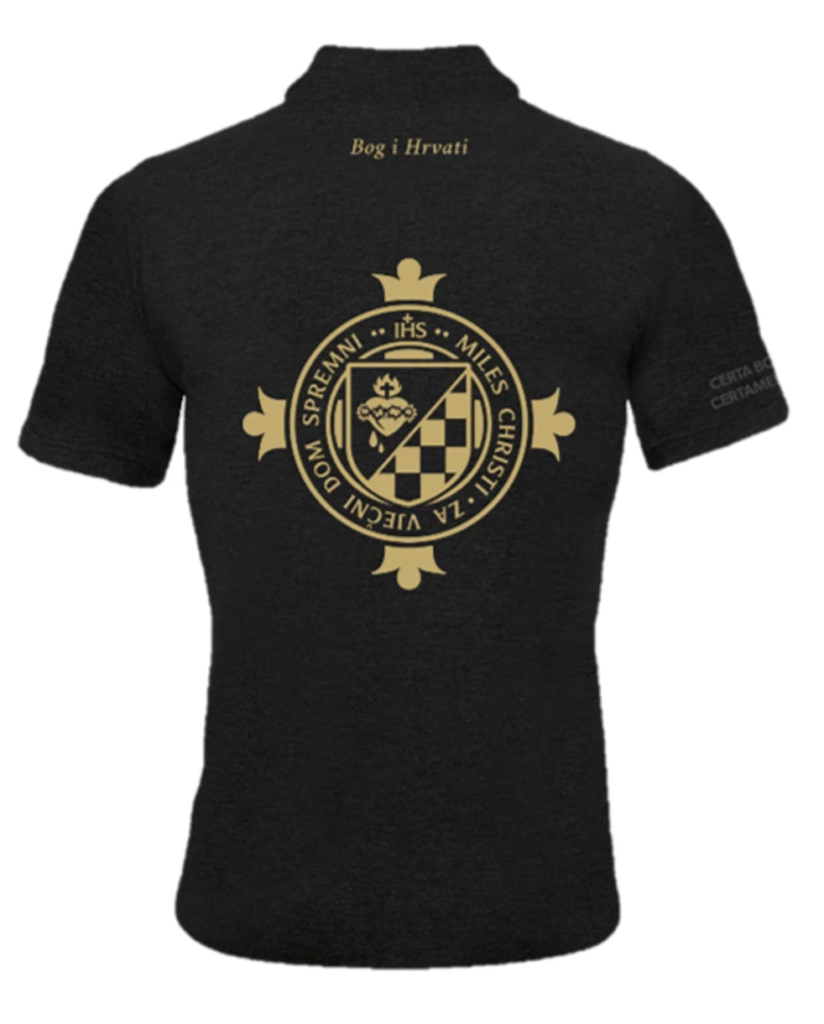
Next we have the Latin text “Miles Christi” (soldier of Christ or Knight of Christ), we acknowledge that we are soldiers of Christ by virtue of our confirmation.
Following this we have in Croatian our slogan “Za Vjecni Dom Spremni” with this we acknowledge and profess that the most important “Dom” (home or Homeland) is our Vjecni Dom – Eternal Home and that this is the one we need to fight for all our life. In this spiritual battle we need to persevere to the end, hence the slogan “Za Vjecni Dom Spremni” (battle ready for the Eternal Homeland). He that shall persevere to the end, he shall be saved. Mat 24:13.
With this slogan we re-affirm that we are in a spiritual battle we are not fighting against flesh and blood our real enemy is spiritual, “For our wrestling is not against flesh and blood; but against principalities and power, against the rulers of the world of this darkness, against the spirits of wickedness in the high places.” Eph6:12
In the centre we have the shield with the Sacred Heart of Jesus. This design (superimposing Our Lord’s Most Sacred Heart on the Croatian coat-of-arms) inspiration originated with the history of the Sacred heart devotion revealed by our Lord to St Margaret Mary i.e., that the King of France needs to place the image of the Sacred Heart on his standards and his weapons. From this came the inspiration to create the “Miles Christi” Croatian shield which has our traditional shield with the sacred Heart on top. This design was first used on the ‘Miles Christi’ Croatian emblem, created for the inaugural National Croatian Men’s Conference: Miles Christi 2019, and the first Knight’s polo shirt design of the same year. The new shield design used on the current Knights shirt was developed in 2020. In the first half of this shield, the image of the most Sacred Heart of Jesus takes prominence for its significance and meaning.
Let us listen as St Margaret Mary recounts herself the first great Apparition in Paray-le-Monial. In her words, as quoted in Bishop Bougaud’s The Life of St Margaret Mary Alacoque she stated:
“One day on the Feast of St. John the Evangelist, 1674, after having received from my Divine Saviour a favour almost similar to that bestowed upon the beloved Disciple on the evening of the Last Supper, the Divine Heart was represented to me as on a throne of fire and flames, shedding rays on every side brighter than the sun and transparent as crystal.
The Wound which He received upon the Cross appeared there visibly; a crown of thorns encircled the Divine Heart, and It was surmounted by a cross.
These instruments of His Passion signified, as my Divine Master gave me to understand, that it was the unbounded love which He had for men that had been the source of all His sufferings; that from the first moment of His Incarnation all these torments had been present to Him, and that from the first moment the Cross had been, so to say, planted in His Heart; that from that moment He accepted all the pains and humiliations which His Sacred Humanity was to suffer during the course of His mortal life, and even the outrages to which His love for men exposed Him till the end of the world in the Blessed Sacrament.
He gave me to understand afterwards that it was the great desire He had to be perfectly loved by men that had made Him form the design of disclosing to them His Heart, and of giving them in these latter times this last effort of His love, by proposing to them an object and a means so calculated to engage them to love Him, and love Him solidly, opening to them all the treasures of love, mercy, and grace, of sanctification and salvation which It contains, in order that all who should wish to pay and procure for Him all the honour and love which they can, might be enriched in profusion with the divine treasures, of which It is the fruitful and inexhaustible source.”
Sleeve wording
The Latin text “Certa Bonum Certamen Fidei” is from 1 Tim 6:12 and reinforces our calling as soldiers of Christ for these times.
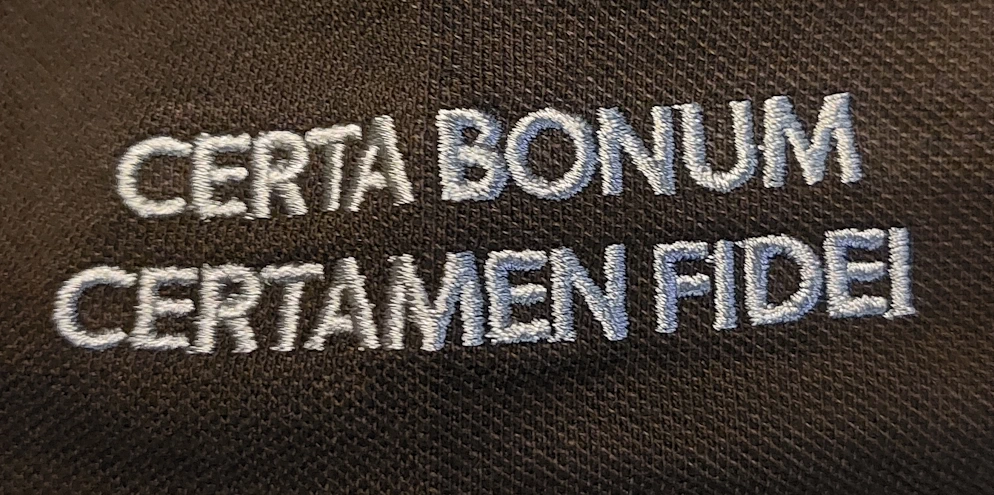
Latin Vulgate Bible
1 Tim 6:12. certa bonum certamen fidei adprehende vitam aeternam in qua vocatus es et confessus bonam confessionem coram multis testibus.
Douay Rheims Bible
1 Tim 6:12. Fight the good fight of faith. Lay hold on eternal life, whereunto thou art called and be it confessed a good confession before many witnesses.
Inside the Shirt
On the inside part of the collar (ie. the back part of the scapular location) where the sizing label is located, we have placed the symbol AMDG on a brown wollen scapular. The other part of the brown wollen scapular is sewn on the front inside just below the buttons.
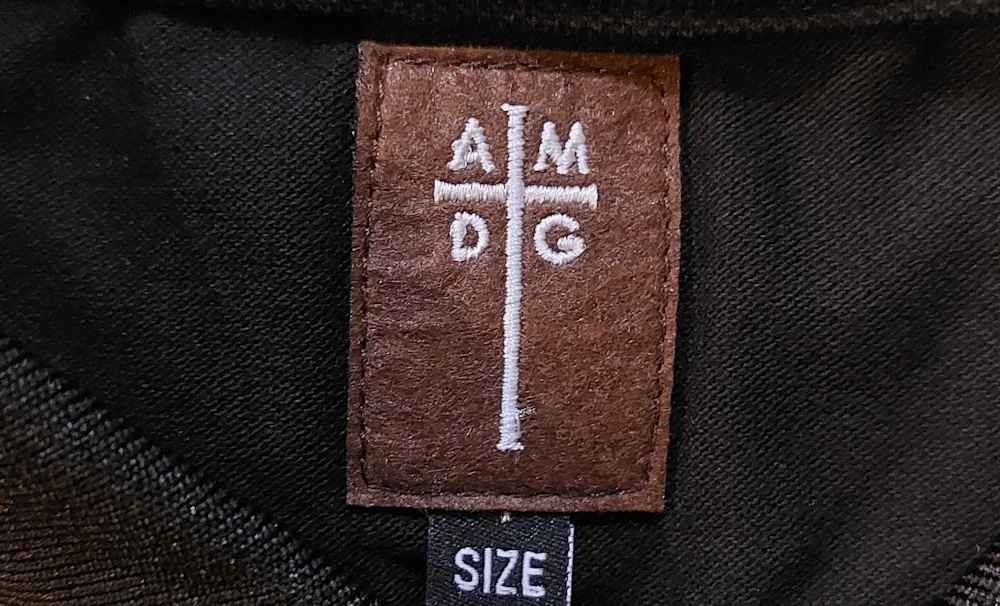
Ad maiorem Dei gloriam also rendered as the abbreviation AMDG, is a Latin quote which can be translated as “For the greater glory of God.” This quote is attributed to St Ignatius of Loyola and the full phrase is Ad maiorem Dei gloriam inque hominum salutem or “for the greater glory of God and the salvation of humanity.” It is a summary of the idea that any work that is not evil, even one that would normally be considered inconsequential to the spiritual life, can be spiritually meritorious if it is performed in order to give glory to God.
We put AMDG on the scapular section of the collar as a reminder to the knights that they are part of something bigger then themselves and that they need to have an endless spirit of gratitude for the gift of life. All their actions should be in the service of God – For His glory alone and in turn for the salvation of souls in the service of others.
Brown Scapular
The Knight’s polo is not just a piece of external attire; it is a symbol of devotion and a mark of consecration. Sewn into the very fabric of the shirt is the Brown Scapular, consisting of two pieces of brown wool: one positioned at the back of the neck and the other at the centre chest, beneath the button section. This placement serves as a constant reminder of the knight’s dedication to Our Lady, fostering a deep connection to her protective mantle.
The Brown Scapular is a powerful sacramental, a sign of our consecration to the Blessed Virgin Mary. As St. Alphonsus Liguori beautifully states: “The Most Holy Mary is pleased when Her servants wear Her Scapular as a mark that they have dedicated themselves to Her service, and are members of the Family of the Mother of God.” By wearing this sacred garment, knights openly declare their loyalty to Our Lady and their commitment to living under her guidance and protection.
This tradition is further affirmed by Sister Lucy, one of the visionaries of Fatima, who recounted to Father Howard Rafferty in 1950 that “Our Lady held the Scapular in Her hands [during the last apparition at Fatima on October 13, 1917] because She wants us all to wear it.” This divine instruction underscores the importance of the Scapular as a heavenly gift meant for all the faithful.
The full promise of Our Lady of Mount Carmel to Saint Simon Stock on July 16, 1251, remains a beacon of hope and assurance: “Accept this Scapular. It shall be a sign of salvation, a protection in danger, and a pledge of peace. Whosoever dies clothed in this Scapular shall not suffer eternal fire.” These words offer profound consolation and inspire knights to embrace the Scapular as a shield of faith and a symbol of eternal security.
Wearing the Brown Scapular is not merely a pious custom but a declaration of trust in Our Lady’s promises. For the knight, it is a sacred badge of honor, a daily reminder of their spiritual mission, and a testament to their unwavering dedication to the Queen of Heaven.
What is the Sabbatine Privilege?
It is a pious belief, rooted in the tradition of the Church, that the Blessed Virgin Mary appeared to Pope John XXII in a vision, granting a profound promise to her faithful children who devoutly wear the Brown Scapular. She assured that these souls would be delivered from purgatory soon after their death, notably on the first Saturday following their passing. In this vision, the Blessed Mother declared: “As a tender Mother, I will descend into purgatory on the Saturday after their death, and will deliver them into the heavenly mansions of life everlasting.”
This remarkable promise is known as the Sabbatine Privilege, named after the Sabbath day (Saturday) on which this deliverance occurs. It was formally promulgated and taught through the famous Bull Sacratissimo Uti Culmine (the Sabbatine Bull) issued by Pope John XXII in 1322. The Sabbatine Privilege was further clarified and given definitive ratification by the Holy See in 1908, reaffirming the Church’s recognition of the Blessed Virgin’s merciful intercession for those devoted to her through the Scapular.
What are the requirements for obtaining the Sabbatine Privilege?
1.To wear the Brown Scapular continuously.
2.To observe chastity according to one’s state in life.
3.The daily recitation of the Little Office of the Blessed Virgin Mary OR to abstain from meat on Wednesdays and Saturdays OR with the permission of a priest say 5 decades of the Holy Rosary.